
"Should I be practicing exercises?"
That’s the question that Darshan, a new subscriber to Play & Sing, asked me recently. He’s a beginner who was particularly curious about the often-recommended exercises published in 1900 by Charles-Louis Hanon.
I thought my answer might be helpful to others, too, so here’s what I said. Continue reading
Update: Where to Get Free Chord Sheets
For years, I’ve been telling my online students about Wikifonia.org. It’s been a great place to get free chord sheets for your favorite songs.
Well, Wikifonia has been unavailable for weeks, so it may be discontinued.
The good news is that there’s now an even better source for free chord charts: Ultimate-Guitar.com. It has everything Wikifonia did. (Except that melodies are not written out–but you don’t need that to play an accompaniment.) And Ultimate-Guitar has a much bigger selection of songs than Wikifonia did. Like Wikifonia, Ultimate-Guitar will also transpose (change keys) for you.
To the best of my understanding, Ultimate-Guitar is now fully legal, meaning it has some sort of arrangement with the publishers, and composers get paid for their efforts. So I now have no qualms whatsoever about recommending it.
Enjoy!
New Tutorial: How to Use the Sustain Pedal on the Piano or Keyboard
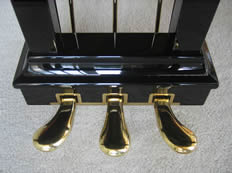
If you haven’t begun to use the pedal yet, you’re in for a thrill when you hear what a huge difference it can make in your playing. And if you are using it but without really knowing what you’re doing, I’ll show you how to get the most out of this essential tool.
I’m talking about the sustain pedal, or damper pedal. On an acoustic piano, it’s the one on the right. On a keyboard, it’s a separate device that sits on the floor and attaches to the instrument via a cable. Continue reading
Two New Piano Tutorials
Just a brief note to let you know I just put up two new lessons. “A Quick-Start Guide to the Piano: Playing Your First Piece” fits near the beginning of the Play & Sing course, and a tutorial on John Lennon’s Imagine goes at the end. You can find out more about these lessons by going to the complete course list.
Enjoy!
Dance While You Play! (Rhythm's in your body, not your head)
Today’s my first day back from vacation, and I want to share with you something that just happened.
I haven’t been playing the piano recently because I know how important it is, sometimes, to get away from my musical pursuits. And this morning, when I sat down to play, I couldn’t regain the excitement I usually feel.
And then I remembered the secret I keep forgetting and re-discovering: Continue reading
Chord Study: What's really important?
A recent visitor to DoctorKeys asked me why my course doesn’t get into more complex chords like 9ths, 11ths, and 13ths. (1/26/15 Update: My newest course, Pop Piano Accompaniment, does indeed teach 9th chords.)
It’s because our focus so far has been on building a strong foundation, on helping you to grasp simple chords in a truly practical way, before moving on to more advanced harmonies.
As a teacher, I’ve learned over the years that students can often build the most complicated chords without knowing how to actually use even the simplest, including: Continue reading
New Tutorial: Piano Technique–A Whole-Body Approach
Finally, it’s online, and I think you’ll find it helpful. The lesson is perfect for beginners, but also for more advanced students who know there’s more to piano technique than what you do with your fingers.
Here’s the video for Part 1. You can read more about it here.
Sheet music for Prelude in C now available
Some of you have asked about the sheet music for the piece I play at the start of Piano Technique: A Whole-Body Approach. Well, with just a few clicks, you can now instantly download and print out a beautifully edited and fingered score of it, and be playing it within minutes. Watch me play Prelude, and/or purchase it here.
My online students are animals!
No–I’m not badmouthing anyone. I’m just stating a fact.
You see, there’s a website that allows me to gain certain information about DoctorKeys users. Because when I see a pattern of frequent visits, I sometimes can’t resist typing in the internet address to see what part of the world all that love is coming from. Continue reading
Free Chord Charts and Where to Get Them
As you may know, I’ve been talking up Wikifonia.org as a great place to go for free lead sheets. Wiifonia will even transpose songs into your key, and give you beautiful files, ready to print. Well, I just found another free online source. Each has its pros and cons. Continue reading